

Homebot One / Access Research

Access

Hands that
can sign.

KOKO is learning sign language, so a home robot can talk with Deaf people in their own language.

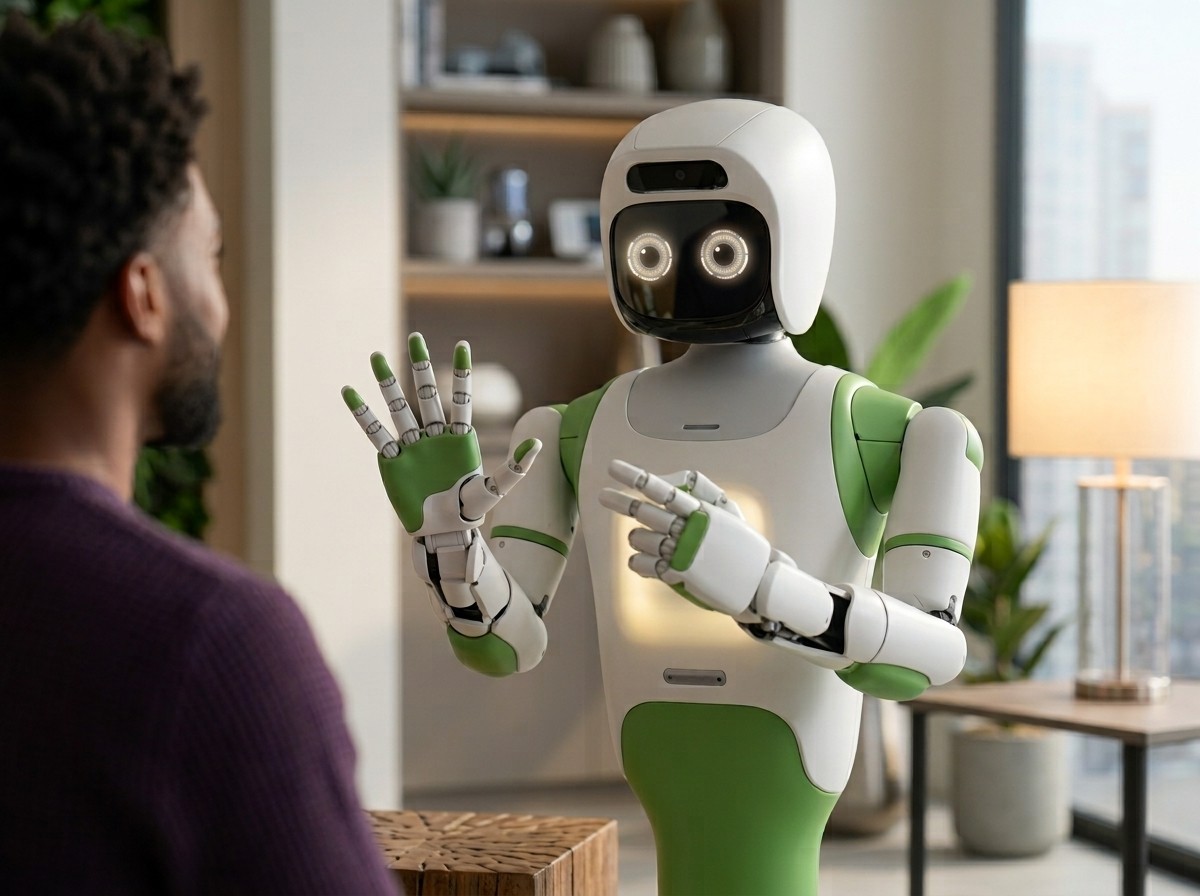
KOKO, a white and green home robot on a wheeled base, raises both hands to form a sign with its jointed fingers. A smiling man in a purple sweater, seated in an armchair in a bright, plant-filled apartment, signs back to it.>
KOKO signing at home with individually jointed fingers.

Built with Deaf signers, not just for them.

Most home technology assumes you can hear it. Voice assistants talk, alarms beep, robots answer out loud. For Deaf people whose first language is sign, that leaves a lot out.

We're teaching KOKO to sign, and we're doing it with fluent Deaf signers who guide what it learns and tell us when it gets things wrong. We would rather show less, and have all of it be right.

What KOKO is learning

A human hand fingerspelling the letter K
Human · K
A human hand fingerspelling the letter O
Human · O
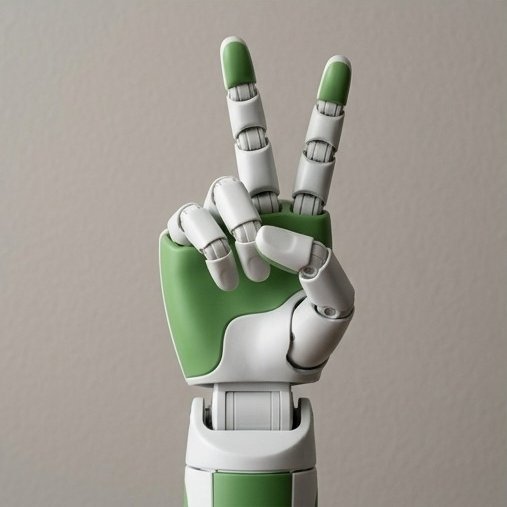
KOKO's hand fingerspelling the letter K
KOKO · K
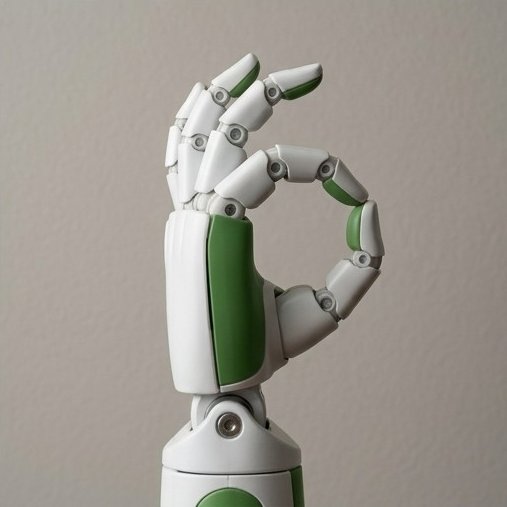
KOKO's hand fingerspelling the letter O
KOKO · O
01 · Fingerspelling

Every letter, by hand

Each of KOKO's fingers moves on its own, so it can form the handshapes of the fingerspelled alphabet clearly enough to read: names, places, and words that don't have a sign.

  • Full fingerspelled alphabet
  • Paced so it's comfortable to read
  • Repeats on request
Seen over a man's shoulder, KOKO faces him from the waist up, both hands raised with fingers spread, its face display showing two round glowing eyes.
02 · Everyday signs

More than handshapes

Sign language uses the face, the head and the space around the body, not just the hands. KOKO uses its face display and head direction alongside its hands to carry meaning.

  • A small set of everyday signs and phrases
  • Face display and head movement as part of each sign
  • Not a replacement for human interpreters

How it's built

A body made to sign.

Jointed fingers

Each finger moves independently, so KOKO can form the precise handshapes that signing needs.

Expressive face

A display that shows the facial expressions sign language relies on, like questions, emphasis and emotion.

Turning head

KOKO faces the person it's signing to and uses head direction the way signers do.

HCI research

The questions we're studying.

A robot that signs raises open human–computer interaction questions. We're studying them in the open, with Deaf researchers and participants, and we'll share what we learn.

RQ1 · Legibility

Can people read it?

How accurately and comfortably do Deaf signers understand KOKO's fingerspelling and signs, compared with a human signer? Which handshapes, speeds and viewing angles break down?

RQ2 · Non-manual signals

Can a face display carry grammar?

Studies of signing avatars found Deaf users care most about facial expression and natural movement, not just the hands [2]. Can a robot's face display and head movement do that work?

RQ3 · Embodiment

Does a physical body help?

Prior work compared physical and virtual robots for sign language tutoring [4]. In a real home, is a signing robot clearer or more welcome than a signing screen?

RQ4 · Appropriate use

Where should it sign, and where not?

Deaf organizations caution against replacing human interpreters, especially for important information [3]. Which everyday moments do Deaf people actually want a signing robot for?

How we study it

Deaf-led co-design
Workshops held in sign language, with Deaf co-researchers shaping the questions, not only answering them.
Legibility studies
Deaf signers identify signs performed by KOKO and by human signers, so we can measure the gap and close it.
Focus groups and surveys in sign language
Every question offered in sign language video, following accessible methods from prior avatar research [2].
In-home field studies
Longer-term use in Deaf households, because a lab can't tell us what daily life will.
Ethics
Informed consent in sign language, paid participation, and video data handled with care and deleted on request.

Related work

  1. Bragg et al. (2019). Sign Language Recognition, Generation, and Translation: An Interdisciplinary Perspective. ACM ASSETS. doi Argues sign language technology needs Deaf communities, linguists and engineers working together.
  2. Kipp, Nguyen, Heloir & Matthes (2011). Assessing the Deaf User Perspective on Sign Language Avatars. ACM ASSETS. doi Focus groups and an online study held in German Sign Language. Participants rated facial expression and natural movement as most important.
  3. World Federation of the Deaf & WASLI (2018). Statement on the Use of Signing Avatars. pdf Cautions against using signing avatars in place of human interpreters, especially for live or important information.
  4. Kose, Uluer, Akalin, Yorganci, Ozkul & Ince (2015). The Effect of Embodiment in Sign Language Tutoring with Assistive Humanoid Robots. International Journal of Social Robotics 7(4). NAO and Robovie robots teaching Turkish Sign Language. Compares physical and virtual embodiment.
  5. Meghdari, Alemi, Zakipour & Kashanian (2018). Design and Realization of a Sign Language Educational Humanoid Robot (RASA). Journal of Intelligent & Robotic Systems. doi A 29-degree-of-freedom upper body built for Persian Sign Language.
  6. Project Aslan, University of Antwerp (2017). 3D-printed robotic arm for fingerspelling. article A student project for Flemish Sign Language, positioned as a supplement to human interpreters, not a replacement.

Our commitments

How we work.

  1. Led by Deaf signers

    Fluent Deaf signers shape what KOKO learns and review every sign before it ships, and they are paid for their expertise.

  2. Honest about limits

    KOKO knows a small set of signs, not a whole language. We say clearly what it can't do yet.

  3. Not an interpreter

    For medical, legal and other important conversations, people deserve a qualified human interpreter. KOKO doesn't replace one.

  4. Respect for the language

    Sign languages are full languages with their own grammar and culture. We build KOKO to respect that, not to simplify it.

Build this with us.

We're looking for Deaf organizations, signers, sign language educators and HCI researchers to co-design, study and test KOKO's signing. If that's you, we'd love to talk.

Get in touch